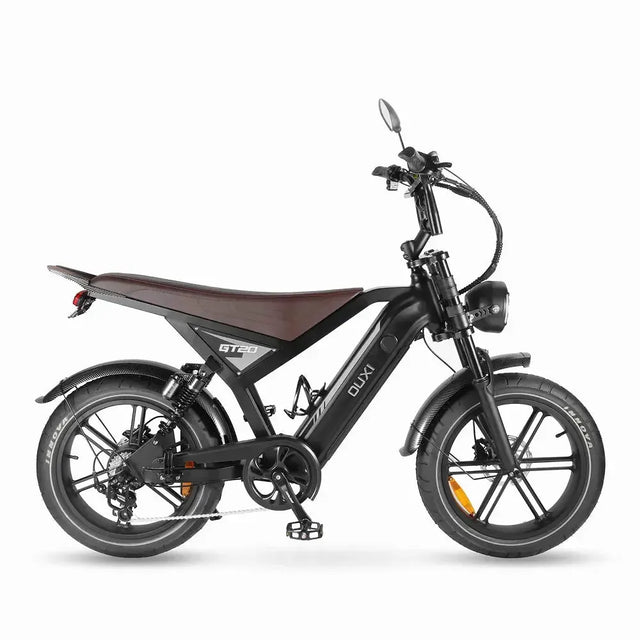
Fat bike or mountain bike: which one should you choose?
It depends on where you ride. If you mainly ride on trails, in the woods, or in the mountains, a mountain bike is designed specifically for that. For going to school, work, or grocery shopping, an electric fat bike may be a good choice. In that case, compare tires, weight, suspension, and brakes from model to model.
We sell electric fat bikes and recommend them for everyday travel, not for sport mountain biking. Below, you’ll find the differences between the two, with data from the manufacturers. The models mentioned are listed at the bottom of the page.
What does fat bike mean?
In English, fat means fat: a fat bike is recognizable by its very wide tires. In this article, we’re talking about electric fat bikes like those in our collection.
A mountain bike, or MTB, is a bike made for trails, climbs, and descents. There are also electric versions, called e-MTBs.
Tires: the visible difference
According to ENGWE, the ENGWE E26 has 26 x 4.0-inch tires. For the OUXI GT-20, OUXI specifies 20 x 4.0 inches. The first number is the wheel diameter, and the second is the tire width, both measured in inches.
On a mountain bike, the width depends on the model. Compare the number in the technical specifications: it is read the same way.
Weight: something to carry, not pedal
An electric fat bike comes with a motor and battery to carry around. The ENGWE E26 weighs 34.5 kg according to ENGWE, in the high-step frame version. The JOBOBIKE Robin Pro weighs 34.6 kg according to JOBOBIKE.
On the road, the motor helps you pedal. On stairs, in a basement, or when loading it into a car, however, you have to carry it yourself. If you need to lift it often, check the weight before choosing.
Hardtail or full suspension?
A hardtail bike has only a suspension fork at the front. A full-suspension bike has suspension at both the front and rear.
Among fat bikes, you’ll find both types. For the OUXI GT-20, OUXI specifies front and rear suspension. For the V20 Comfort Pro, the manufacturer QMWHEEL refers to dual suspension. The JOBOBIKE Robin Pro, on the other hand, has a suspension fork and suspension seat post according to JOBOBIKE, but no rear suspension. So read the specifications carefully: “suspension” may refer only to the fork.
What about the brakes?
Here too, it’s best to look at the model rather than the type of bike. According to the manufacturers, the ENGWE E26 and JOBOBIKE Robin Pro have hydraulic disc brakes with 180 mm rotors. For the S20 Pro, the manufacturer QMWHEEL specifies hydraulic disc brakes.
The JOBOBIKE Robin ST, on the other hand, has Tektro mechanical disc brakes, also with 180 mm rotors according to JOBOBIKE.
Which should you choose for your route?
- School, work, and grocery shopping in the city: an electric fat bike, if the weight isn’t a problem for you.
- Trails, woods, and mountain rides at the weekend: a mountain bike.
- Motor assistance without wide tires: take a look at our electric bikes.
Want both things in a single bike? Choose based on the route you ride most often.
Which fatbike is right for you?
Compare the models below. View the latest information for each bike on its product page.

OUXI GT16 Pro, Black

Ouxi GT-2000, Off-road fatbike, Black

V20 Pro Mini, Black
OUXI GT-20: sospensioni davanti e dietro
Secondo OUXI la OUXI GT-20 ha gomme da 20 x 4,0 pollici, sospensioni anteriori e posteriori, 7 marce e freni a disco idraulici Tektro a 4 pistoncini. La portata massima indicata è di 150 kg.