Can you ride the Fatbike in winter and snow?
You can also ride an E-Fatbike in winter, but thick tires are not winter tires. There are special pedelec tires for ice and snow, and even with those you should ride carefully. Cold reduces range, and in freezing temperatures the battery belongs indoors. We do not sell our E-Fatbikes for tours in deep snow.
Below, you’ll read what wide tires can and cannot do in snow, how to get your battery through the winter, and what to watch out for during the darker season. The examples come from our Fatbikes.
What can thick tires do in snow?
Anyone searching for “Fatbike in winter” mainly finds tours: at the Arctic Circle, in the Alps, and in snowy forests. That has little to do with commuting to work in January. There, you’re dealing with slush, grit, packed snow, and places where it’s slippery.
Wide tires alone do not make a bike suitable for winter, and we would not rely on tire width alone in slippery conditions. According to the ADFC, there are special tires for ice and snow that are suitable for pedelecs. And even with those, you still need to ride carefully.
Can you simply fit studded tires?
Not without further consideration. According to the ADFC, pedelecs fall under the Machinery Directive, which does not allow parts to be replaced freely: a replacement part must be identical in design or approved by the manufacturer. This also applies to tires. So ask beforehand whether a winter tire in your size is approved for your model.
One thing always applies: Tire pressure must be within the range stated on the tire sidewall. According to the ADFC, insufficient pressure uses more battery power, increases wear, and makes punctures more likely. So check it just as regularly in winter.
What does cold do to the battery?
According to the ADAC, common batteries deliver less power than in warm conditions from around 5 degrees Celsius onward, reducing range. So expect shorter distances per charge in winter. This applies just as much to the OUXI V8 Ultra with 720 Wh as to the OUXI V8 Ultra Max with two batteries and a combined capacity of 1440 Wh.
Snow and rain themselves do not damage the battery: according to the ADAC, riding in rain or snow does not impair it. For riding in cold air, the ADAC recommends a neoprene cover to protect against cold and moisture.
Can the E-Fatbike stay outside in winter?
The bike can, but it’s better to bring the battery inside. At temperatures below freezing, the ADAC recommends removing the battery when parking and storing it at room temperature. It’s best to check before buying whether the battery can be removed from your model, especially if you do not have a frost-free place to store it.
You should not charge it outside on the bike when it’s cold. If it comes in from the cold, wait to charge it until it has reached room temperature. If you put the bike away for several weeks, store the battery separately from the charger at 5 to 20 degrees Celsius. Some manufacturers, such as Bosch, recommend a charge level of 30 to 60 percent for this; follow your bike’s instructions.
Brakes, lights, and slippery conditions in the city
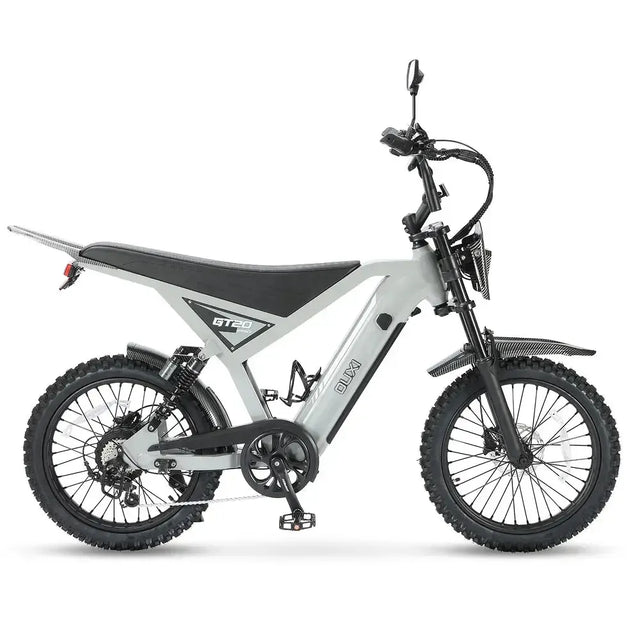
According to the ADAC, disc brakes are not particularly susceptible to cold and moisture. The OUXI V8 Ultra, the OUXI GT-20 Pro, and the V20 Cross have hydraulic disc brakes according to the manufacturer.
It gets dark early in winter, and you should use lights by dusk at the latest. The headlight, rear light, and reflectors must work and be fitted correctly (StVZO § 67). Removable lights are permitted, but they must be attached at dusk and in the dark.
It’s not only ice that makes surfaces slippery. The ADAC warns about leaves, manhole covers, and fresh road markings. Cross tram tracks at as close to a right angle as possible.
When is an E-Fatbike the wrong choice in winter?
If you want to go on tours in deep snow: that is not what we sell our bikes for. If you have no indoor space for the battery, every freezing day will reduce your range. And when there is black ice, leave the bike at home if in doubt.
Which fatbike suits you?
Compare the models below. Check each product page for the latest details.

ENGWE E26, High Step, Black
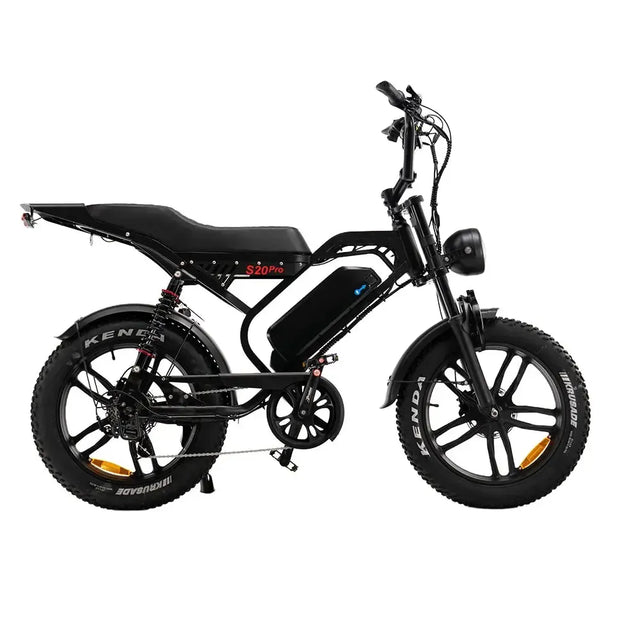
S20 Pro, Black

V20 Pro, Skinny Bike, Black
OUXI GT-20 Pro: hydraulisch gebremst, vorn und hinten
Laut OUXI hat das GT-20 Pro hydraulische Scheibenbremsen vorn und hinten. Scheibenbremsen sind laut ADAC nicht sehr anfällig für Kälte und Nässe. Die Reifen messen 20 x 4,0 Zoll.