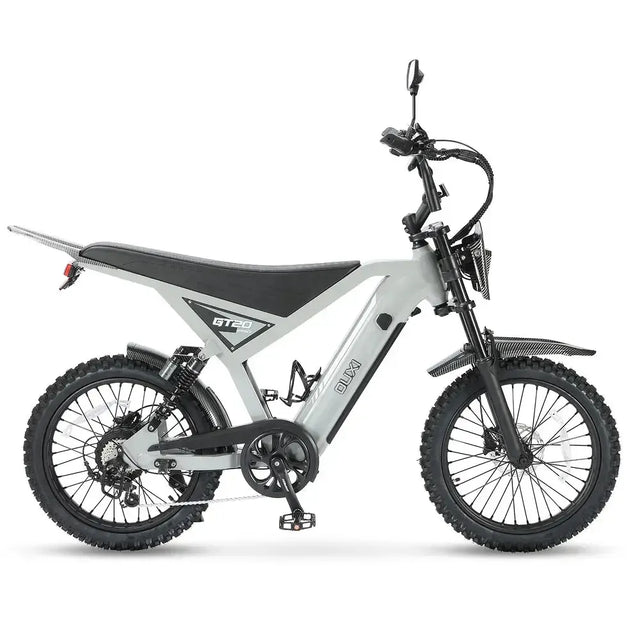
Fatbike or mountain bike: which one suits you?
If you mainly ride trails, roots, and steep forest paths, choose a mountain bike. If you ride to work, school, or the shops and want to sit comfortably, an E-Fatbike is a better fit. We sell E-Fatbikes for urban routes, not sports equipment for off-road use. We do not sell mountain bikes.
Below, you’ll read how the two differ, what suspension, weight, and the motor mean, and what legally applies to both. The examples come from our Fatbikes.
What is each bike designed for?
A mountain bike is made for off-road riding: climbs, descents, roots, and rocks. An E-Fatbike, like the ones we sell, is designed for the city: cycle paths, traffic lights, the route to school, and the occasional dirt road.
What makes this confusing is that the term Fatbike is also used in the mountain biking world. Reports about rides in deep snow are referring to off-road Fatbikes. These are different bikes from the E-Fatbikes discussed here.
Hardtail, full-suspension, or Fatbike?
Hardtail means suspension only at the front. Full-suspension means suspension at the front and rear. You know these terms from mountain biking, but they also apply to E-Fatbikes. According to OUXI, the OUXI V8 Ultra and the OUXI GT-24 have front and rear suspension.
With a mountain bike, suspension is about control off-road. With an E-Fatbike in the city, it is about comfort on kerbs and poor asphalt. Before buying, check whether a bike has front suspension only or suspension at both the front and rear.
Weight and tyres: the difference in everyday use
E-Fatbikes are heavy. The JOBOBIKE Robin Pro from our E-Bikes, an E-Fatbike with 26 x 4.0-inch tyres, weighs around 35 kilos according to JOBOBIKE. On a trail, where you lift the bike over obstacles or push it uphill, that is a lot. In the city, you mainly ride and park it; the weight only becomes an issue when stairs are involved.
According to OUXI, the OUXI V8 Ultra runs on 20 x 4.0-inch tyres, while the OUXI GT-24 has 24 x 4.0-inch tyres. This provides plenty of air volume, but requires more effort when pedalling. On an E-Fatbike, the motor compensates for this.
Motor: where it is located changes the ride feel
According to ADAC, a mid-drive motor rides similarly to a conventional bicycle. A hub motor in the rear wheel provides good traction, but makes it harder to lift the bike up stairs. If the motor is in the front wheel, the bike can spin or slide on slippery surfaces, inclines, or bends.
For steep trails, this is an important point; for the commute to work, it is less so. In either case, check where the motor is located before making your decision.
Can I ride an E-Fatbike off-road?
To some extent. A dirt road or a gravel path through the park is different from a trail with roots and steps.
We do not sell our bikes for trails with jumps and steep descents. If you regularly want to ride off-road, a mountain bike is the more honest choice.
What applies legally to both?
For legal purposes, it does not matter whether a bike is called a Fatbike or a mountain bike; what matters is the motor. A pedelec with a maximum continuous rated power of 250 watts, which only provides assistance while pedalling and only up to 25 km/h, is classified as a bicycle (StVG § 1 para. 3). If the motor provides assistance up to 45 km/h, it is an S-Pedelec and therefore a motor vehicle: you need at least an AM driving licence, an insurance plate, and a helmet, and cycle paths are generally off-limits (ADAC).
There is no legal helmet requirement for pedelecs. However, according to ADAC, anyone who rides a mountain bike for sport may be partly held responsible after an accident if they were not wearing a helmet.
Which bike for which journey?
- Daily through the city, with shopping: E-Fatbike.
- At weekends on trails and in the mountains: mountain bike.
- Long distances at speed on asphalt: a bike with narrower tyres, such as a Skinny Bike or an E-Bike with narrow tyres.
If you want one bike for both, base your decision on the route you ride most often.
Which fatbike suits you?
Compare the models below. Check each product page for the latest details.

ENGWE E26, High Step, Black
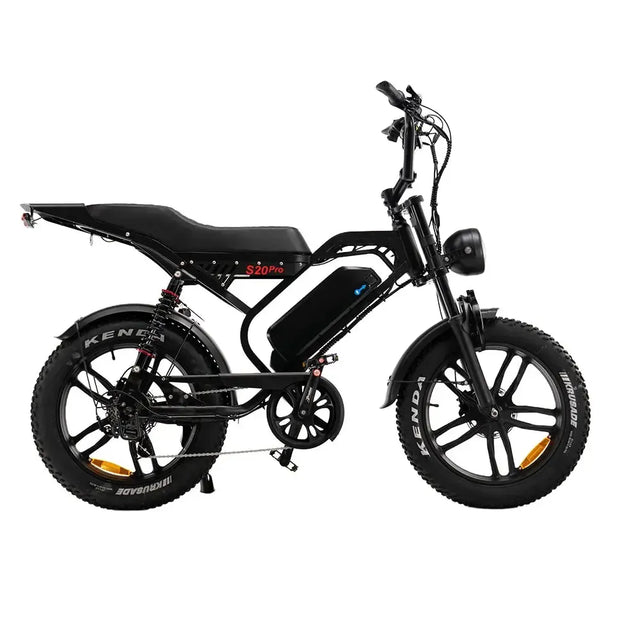
S20 Pro, Black

V20 Pro, Skinny Bike, Black
OUXI GT-20 Pro: 20 x 4,0 Zoll und hydraulische Bremsen
Breite Reifen in 20 x 4,0 Zoll und hydraulische Scheibenbremsen vorn und hinten: Das sind die Angaben von OUXI zum GT-20 Pro.