


How many bar should a fatbike tire have?
There is no single bar pressure that is right for every fatbike. The sidewall of your tyre shows the minimum and maximum pressure it can handle. Stay within that range, and use a higher pressure as you and your luggage get heavier. For example, the Schwalbe Jumbo Jim, a 26 x 4.00-inch fatbike tyre, can handle 0.4 to 2 bar.
Below, you can read why a fatbike tyre needs less air than a regular bicycle tyre, what happens when your tyre is too soft or too hard, and how to inflate it properly. At the bottom, you will find fatbikes to compare.
Where is the tyre pressure listed on your fatbike tyre?
Look at the sidewall of the tyre. The ANWB specifically points this out for unusual tyres such as those on a fatbike: it shows the minimum and maximum tyre pressure. Schwalbe and Continental are clear: do not go below the minimum or above the maximum.
The tyre size is listed on the same sidewall. The ETRTO size indicates the width in millimetres and the inner diameter, Schwalbe explains. A 26 x 4.00-inch fatbike tyre is 100-559 at Schwalbe and 98-559 at Kenda. So a 4-inch tyre is not equally wide across every brand.
Why does a fatbike tyre need less bar pressure?
Because it is so wide. According to a DTV report for the Ministry of Infrastructure and Water Management, most fatbikes sold have tyres of around 4.0 inches, or about 10 centimetres. According to the same report, conventional city bikes mainly have tyres measuring 1.75 to 2.75 inches.
Wide tyres are generally used at a lower pressure, Schwalbe writes. The brand says that the Jumbo Jim's large volume allows it to be ridden at extremely low air pressure. A table for regular bicycle tyres therefore does not help: the Schwalbe table referred to by the ANWB only goes up to a tyre width of 60 mm.
What is the correct tyre pressure for a V20?
That is determined by the tyre fitted to it, not by the name of the bike. A study by Goudappel for the ministry describes the V20 as a fatbike sold under various brand names, in versions that differ from one another. Schwalbe also states that it cannot recommend a general air pressure for a particular bike or tyre: the correct pressure depends mainly on the weight of the rider and the luggage.
So always check your own tyre. The sizes also vary among our fatbikes. According to the manufacturers, the S20 Pro and the OUXI GT-20 have 20 x 4.0-inch tyres, while the ENGWE E26 and the JOBOBIKE Robin Pro have 26 x 4.0-inch tyres.
Is 3 bar too much for a fatbike tyre?
That depends on the maximum pressure shown on your tyre. For the Schwalbe Jumbo Jim, it is 2 bar, so 3 bar is too much. Never inflate above the maximum, Continental warns: the tyre could jump off the rim or burst while riding.
Within the permitted range, harder is not always better. On a smooth road surface, a harder tyre rolls more easily and wears less, Schwalbe writes, but a softer tyre provides more comfort and grip. According to the Fietsersbond, exactly where you set the pressure depends strongly on your personal preference.
What happens if your fatbike tyre is too soft?
It may not be able to support the weight properly and will deform too much while rolling. Over time, the sidewall becomes overloaded and tears. According to Schwalbe, sidewalls often break before the tread is worn out, and in the vast majority of cases this is caused by riding with too little air. Cracks in the sidewall are a sign that the pressure has been too low for a long time.
According to Schwalbe, the risk of a puncture increases considerably, and Continental warns that the inner tube can be pinched when the pressure is too low. On the road, a soft tyre also rolls more heavily, even when it is 4 inches wide. The Bicycle Rolling Resistance test lab measured rolling resistance of 38.6 watts at 8 psi for a Jumbo Jim (SnakeSkin), compared with 23.7 watts at 12 psi. However, this involved one individual tyre on a test drum, not a fatbike on the road.
How do you inflate a fatbike tyre properly?
Use a pump with a pressure gauge so that you can read the pressure instead of estimating it. Continental and the Fietsersbond both recommend this. According to Bosch, pressing your thumb into the tyre is not a reliable method. If the gauge only shows psi: one bar is 14.5 psi.
Check the pressure at least once a month, Schwalbe and Bosch recommend. Every inner tube loses air over time, Bosch writes. According to Schwalbe, this happens considerably more slowly at low pressure than at high pressure.
Which fatbike suits you?
Compare the models below. Check each product page for the latest details.
ENGWE E26: hoge instap op 26 x 4,0 inch
Banden van 26 x 4,0 inch, hydraulische schijfremmen van 180 mm voor en achter en 7 versnellingen van Shimano. Hij weegt rond 35 kilo, dus hij is niet licht om te tillen. Hoeveel bar in de banden hoort, staat op de zijkant van de band.

S20 Pro: fatbike op banden van 20 x 4,0 inch
Een fatbike op banden van 20 x 4,0 inch, met hydraulische schijfremmen en achtervering. Het maximale draaggewicht is 150 kilo. Hoe zwaarder je hem belast, hoe hoger je binnen het bereik op de band gaat. Dat bereik lees je op de zijkant van de band die erop zit.
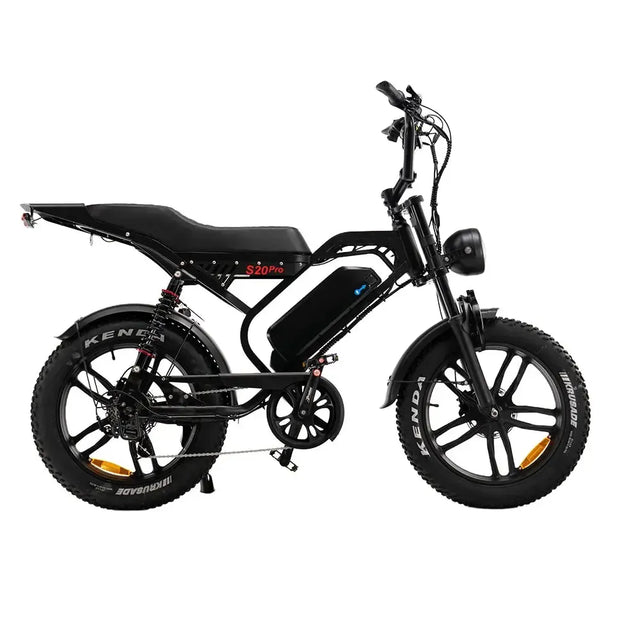

V20 Pro, Skinny Bike, Black
OUXI GT-20 Pro: volgens OUXI op banden van 20 x 4,0 inch
OUXI geeft voor de GT-20 Pro banden van 20 x 4,0 inch op, met hydraulische schijfremmen op het voor- en achterwiel. Hoeveel bar erin hoort, lees je op de zijkant van de band zelf.
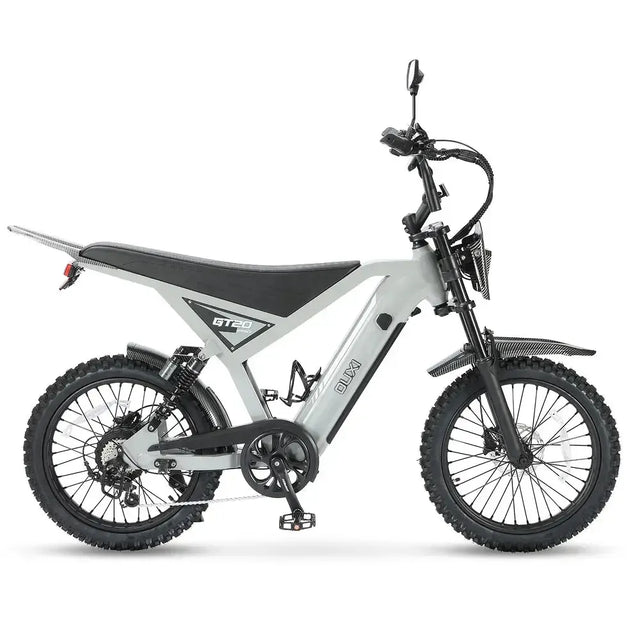
OUXI GT-20: 20 x 4,0 inch en 7 versnellingen
Banden van 20 x 4,0 inch, vering voor en achter en hydraulische Tektro-schijfremmen met 4 zuigers. Hij heeft 7 versnellingen en volgens OUXI een maximaal draaggewicht van 150 kilo. Neem je vaak bagage mee, ga dan binnen het bereik op de band wat hoger zitten.
