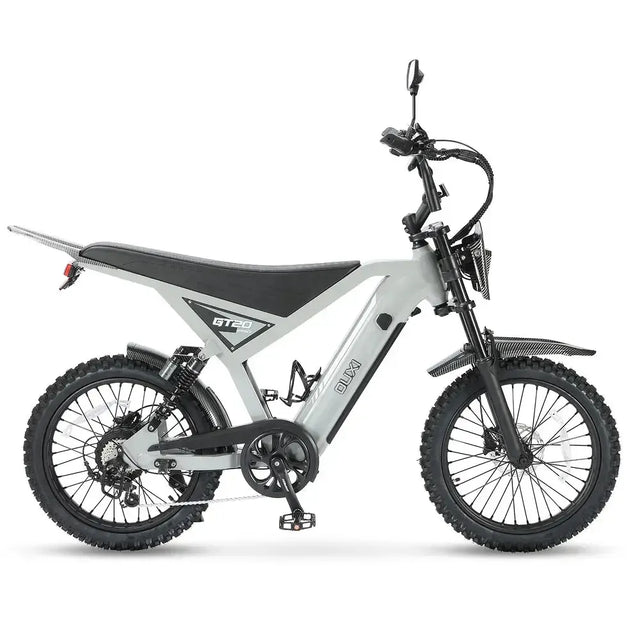
Is a Fatbike worth it? The pros and cons
An E-Fatbike is worth it if you mainly ride in the city and value suspension, wide tires, and comfortable seating. The disadvantages are weight and rolling resistance: An E-Fatbike can weigh considerably more than a narrow E-Bike and is harder to pedal. If you carry your bike up stairs every day, a narrower E-Bike is usually more practical.
Below, we go through the advantages and disadvantages individually, with manufacturer specifications for bikes from our range. Below that, you will find Fatbikes to compare.
What speaks in favor of a Fatbike?
Comfort. Wide tires with plenty of air volume and suspension: That is what E-Fatbikes are designed for. According to OUXI, the OUXI V8 Ultra and the OUXI GT-24 have front and rear suspension.
Carrying capacity. OUXI specifies a payload of up to 150 kilos for the OUXI V8 Ultra, the OUXI V8 Ultra Max, and the OUXI GT-24. However, a high payload does not automatically mean there is room for two people: You may only carry someone if the bike is designed and equipped for it and you are at least 16 years old (StVO § 21 para. 3).
The battery. According to OUXI, the OUXI V8 Ultra has a 720 Wh battery, while the OUXI V8 Ultra Max has two batteries with a combined capacity of 1440 Wh. How far you can go on them depends on your riding style, weight, and temperature.
What speaks against it?
The weight. Two bikes from our E-Bikes show how significant the difference can be: The JOBOBIKE Robin Pro on Fatbike tires measuring 26 x 4.0 inches weighs around 35 kilos according to JOBOBIKE, while the ENGWE Mapfour N1 Air with narrow tires measuring 700 x 38C weighs around 16 kilos according to ENGWE. The ADAC considers even around 25 kilos very awkward to carry when you have to carry an E-Bike up stairs. If you live on the third floor without an elevator, you will notice that every day.
The space. A Fatbike with wide tires needs room in the hallway, bike storage area, and bike rack. Measure the available space before buying to make sure the bike will fit.
Rolling resistance. Thick tires are harder to pedal. The motor compensates for a lot of it, but the battery notices the difference. According to the ADFC, low rolling resistance helps conserve the battery.
Who is a Fatbike suitable for?
For commuting to work, school, and shopping, on asphalt, bike paths, and the occasional dirt track. For anyone who prefers a comfortable rather than sporty riding position. And for anyone who needs a high payload, within the limits specified by the manufacturer.
Where the bike is stored is also important. On the ground floor, in a courtyard, or in a garage, an E-Fatbike is no problem. A cramped basement accessed via a steep staircase is a different matter.
Who is it less suitable for?
If you have to carry your bike every day. If you want to cover long distances quickly: On a pedelec, assistance stops at 25 km/h; above that, you have to pedal the entire weight and the wide tires yourself. If you are looking for trails with roots and steep descents: That is what a mountain bike is made for, and we do not sell our E-Fatbikes for that purpose.
And if the bike needs to fit on a bus, train, or in a car trunk. In that case, an E-folding bike is more practical. If you simply want to travel more lightly, take a look at the E-Bikes with narrow tires.
What is the problem with Fatbikes?
Behind this question, there is often a concern about whether such a bike is even legal. What matters here is not the tire width, but the motor. A pedelec has a maximum rated continuous power of 250 watts and only provides assistance while pedaling, up to 25 km/h. The rules for bicycles then apply (StVG § 1 para. 3).
A throttle is different: If an E-Bike can travel up to 25 km/h without pedaling using a throttle, it is generally a moped according to the ADAC, requiring a helmet, a moped test certificate, and an insurance license plate. So check the product description: What rated continuous power is specified, and is a throttle fitted? If in doubt, ask before buying.
The rest is a matter of taste. Fatbikes stand out, and not everyone likes that.
Which fatbike suits you?
Compare the models below. Check each product page for the latest details.

ENGWE E26, High Step, Black
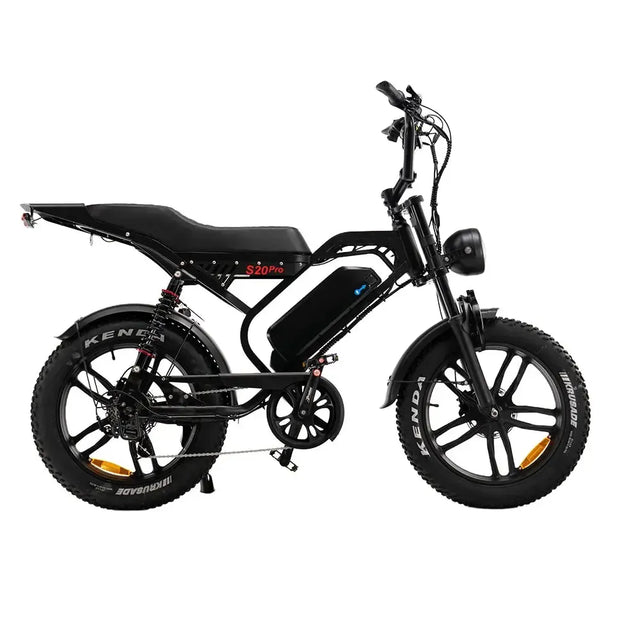
S20 Pro, Black

V20 Pro, Skinny Bike, Black
OUXI GT-20 Pro: breite Reifen, hydraulische Bremsen
Breite Reifen in 20 x 4,0 Zoll und hydraulische Scheibenbremsen vorn und hinten, so beschreibt OUXI das GT-20 Pro. Hydraulische Bremsen empfiehlt der ADAC vor allem bei hohem Körpergewicht oder viel Gepäck.