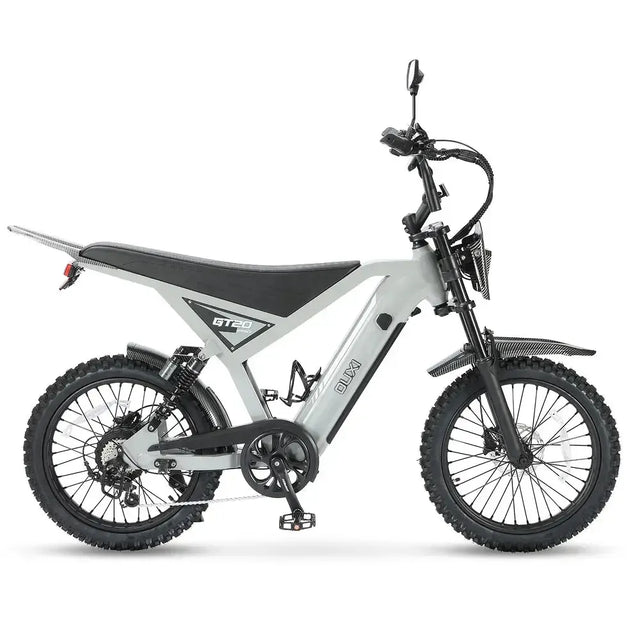
Which e-fatbike is the best?
There is no single test winner for everyone when it comes to E-Fatbikes. Each ranking compares its own selection using its own criteria. Which Fatbike is best for you depends on the battery capacity in watt-hours, the weight, the brakes, your height, and whether the bike is legally a pedelec. We have not conducted our own test.
We sell Fatbikes ourselves and therefore do not name a winner. Instead, this article explains what tests focus on and how you can compare the manufacturers’ specifications yourself. You will find models to compare below the article.
Why every ranking has a different test winner
Search for “Fatbike test winner” and you will find lists with three, eight, or ten models. None of them has ridden every bike on the market. A model that is not included cannot win.
Some rankings come from shops and brands that sell the bikes themselves. That is not prohibited - we sell Fatbikes too. Still, ask yourself when reading: Who tested them, for how long, and using which measurements? If it only says “test winner” without any measurement data, it is more likely a recommendation than a test.
Range: compare watt-hours, not kilometres
ADAC names range, weight, and charging time as the key criteria when choosing an E-Bike. However, the kilometres promised by a manufacturer are difficult to compare. Watt-hours (Wh) are better: volts multiplied by ampere-hours. 48 volts and 15 ampere-hours result in 720 Wh.
According to OUXI, the OUXI V8 Ultra has a battery with exactly these specifications, namely 720 Wh. The OUXI V8 Ultra Max has two such batteries with a combined capacity of 1440 Wh. How much of that reaches the road depends on your riding style, weight, and temperature. ADAC calculates a range of 50 to 100 kilometres per charge for mixed riding, depending on the capacity.
Weight and charging time: what matters in everyday use
If you have to carry your bike up stairs, ADAC advises trying the lifting before buying. From around 25 kilograms, this can become very awkward. Therefore, compare the weight specified by the manufacturer and ask if it is missing.
Charging time should also be on your list. A removable battery is practical: you can charge it in your home while the bike remains in the basement or courtyard. Check before buying whether the battery can be removed.
Brakes, suspension, and sensor
Every bicycle in Germany needs two independent brakes (StVZO § 65). ADAC considers hydraulic brakes particularly advisable for riders with a high body weight or those who frequently transport luggage. According to the manufacturer, the OUXI V8 Ultra, the OUXI GT-20 Pro, and the V20 Cross have hydraulic disc brakes.
Suspension deserves a close look: a suspension fork only provides suspension at the front, while a full-suspension bike also has suspension at the rear. According to OUXI, the OUXI V8 Ultra and the OUXI GT-24 have suspension at both the front and rear. Then there is the sensor: a cadence sensor only detects that you are pedalling, while a torque sensor also measures how hard you are pedalling.
Is the test winner even a pedelec?
A pedelec has a maximum rated continuous power output of 250 watts, only assists while you are pedalling, and stops assisting at the latest at 25 km/h. A start-up or walking-assistance function up to 6 km/h is permitted. It is then legally considered a bicycle (StVG § 1 para. 3).
Pay attention to the term rated continuous power output. Some specification sheets only state the peak power, which is higher. For classification, the rated continuous power output matters, not the peak power. So check the product description to see which rated continuous power output is specified and whether a throttle is installed.
20-inch, 24-inch, or folding bike?
Many people specifically search for tests of 20-inch Fatbikes, 24-inch Fatbikes, or a Fatbike that can be folded. According to OUXI, the OUXI V8 Ultra and the OUXI GT-20 Pro have tyres measuring 20 x 4.0 inches, while the OUXI GT-24 has 24 x 4.0-inch tyres. Wheel size alone says little about whether a bike suits you. Ask before buying what height range the bike is designed for.
If you want to put the bike in the boot or take it on the train, search specifically for a folding bike. You can find them among the E-Folding Bikes.
When you should be sceptical of a ranking
When it lists neither watt-hours nor weight nor rated continuous power output. When a bike with a throttle is at the top and there is no mention of what that means legally: according to ADAC, an E-Bike that travels up to 25 km/h using a throttle without pedalling is usually considered a moped. A helmet, a test certificate, and an insurance registration plate are then mandatory.
And if all the bikes receive a “very good” rating. Then they were probably collected rather than measured.
Which fatbike suits you?
Compare the models below. Check each product page for the latest details.

ENGWE E26, High Step, Black
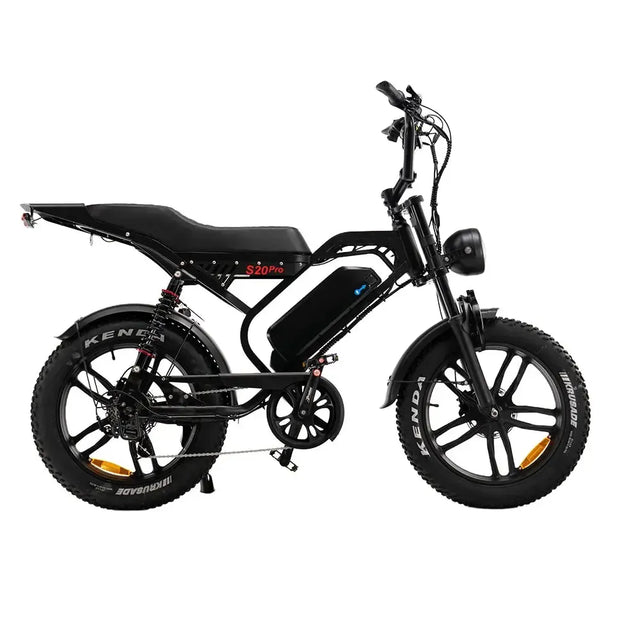
S20 Pro, Black

V20 Pro, Skinny Bike, Black
OUXI GT-20 Pro: 20 x 4,0 Zoll und hydraulische Bremsen
Das GT-20 Pro rollt laut OUXI auf Reifen in 20 x 4,0 Zoll und hat hydraulische Scheibenbremsen vorn und hinten. Hydraulische Bremsen empfiehlt der ADAC vor allem bei hohem Körpergewicht oder viel Gepäck.