


Who invented the fatbike?
The fatbike does not have a single inventor. It originated in two places in the United States: in Alaska, where cyclists began welding rims together in the late 1980s to ride over snow, and in New Mexico, where Ray Molina developed wide rims and tires for sand. Mark Gronewald from Alaska came up with the name fat bike.
Below, you can read who those pioneers were, when the first fatbike came from the factory, and what is known about fatbikes in the Netherlands. At the bottom are fatbikes available today for comparison.
Where does the fatbike come from?
In 2015, Outside magazine wrote that its origins are disputed, with roots in Alaska and the southwestern United States.
Alaska: riding over snow
In 1987, the first Iditabike was held in Alaska: a winter race for cyclists along snowmobile and dogsled trails. Participants looked for the widest rims and tires that would fit on a bicycle, so they would sink less deeply into the snow.
Some welded two rims side by side, with two tires on a single wheel. In the late 1980s, Steve Baker built such a twin wheel and later even one with three rims: the six-pack. In the 1990s, Simon Rakower from Fairbanks made the Snowcat, a rim 44 millimeters wide. It was twice as wide as a regular rim and much lighter than Baker's wheels. For years, winter cyclists in Alaska rode on it.
New Mexico: riding through sand
Around the same time, Ray Molina rode through sand dunes in southern New Mexico and across the border in Mexico. He had rims approximately 80 millimeters wide made in Mexico, with a 3.5-inch tire to go with them: the Chevron. That rim was almost twice as wide as the Snowcat. According to cycling website The Radavist, his company Remolino was the first to bring all the components of a fatbike to market: wide tires, rims, and a frame that could accommodate them.
Who built the first modern fatbike?
At the end of 1999, the two stories came together. At Interbike, a bicycle trade show in Las Vegas, Mark Gronewald from Alaska saw Molina's sand bike. Together with frame builder John Evingson, he built bikes around Remolino's wide rims. According to the Adventure Cycling Association, these were the first modern fatbikes. In 2000, they rode them in the Iditasport, the successor to the Iditabike.
Gronewald sold his bikes under the name Wildfire and called them fat bikes, years before that name caught on. He is often credited with getting the fatbike commercially off the ground, but he himself cites Steve Baker and Ray Molina as inspirations. According to Craig Medred, a former journalist for the Anchorage Daily News, the credit for the first fatbike probably belongs to Baker and Roger Cowles, who built the six-pack together.
When was the fatbike invented?
There is no fixed date: the fatbike developed in stages, from the twin wheels of the late 1980s to the first modern fatbikes around 2000. In 2005, the Surly Pugsley came onto the market, which Outside calls the first mass-produced fatbike. The Adventure Cycling Association and the University of Alaska name the same year. Surly itself writes on its website that the Pugsley has been around since 2003.
Surly also made its own rims and tires, such as the 3.7-inch-wide Endomorph tire, and had the Pugsley produced in large quantities. Gronewald later said that this mass production pushed him out of the market. In 2010, Surly and Salsa introduced the first complete fatbikes.
What does fatbike mean?
Fat is English for thick, referring to the tires. The Dutch government defines a fatbike as an electric bicycle with thick tires. Those wide tires were designed for snow and sand: a tire with a large volume sinks less deeply into loose ground.
Molina's Chevron was 3.5 inches wide, while Surly's Endomorph was 3.7 inches wide. The ENGWE E26 and the JOBOBIKE Robin Pro ride on 26 x 4.0-inch tires. According to Schwalbe and Kenda's size charts, such a tire is 98 to 100 millimeters wide. In its regulations, the municipality of Amsterdam classifies every bicycle with pedal assistance and tires wider than 7 centimeters as a fatbike.
When did the fatbike come to the Netherlands?
The fatbike is not a Dutch invention, and the first fatbikes did not have motors: they were bicycles for winter races and rides through sand. We have not been able to find reliable sources stating when the first fatbike was ridden in the Netherlands.
What is known is how quickly it became popular here. In 2020, one percent of newly sold bicycles were fatbikes; in 2024, that figure was 13 percent. VeiligheidNL reports this based on figures from RAI Vereniging.
How many fatbikes are there in the Netherlands?
That is not known. A parliamentary letter from September 2024 states that there are no figures on the number of fatbikes, and NOS wrote in October 2024 that it is unknown how many fatbikes there are in the Netherlands.
What is known is how many were newly sold in 2024: 111,033 fatbikes, 13 percent of the 858,126 new bicycles sold that year. This is shown by research conducted by GfK for BOVAG and RAI Vereniging. We have not yet found a fatbike figure for 2025.
Why are fatbikes so popular?
We have not found a study into the cause. Veilig Verkeer Nederland (VVN) did provide an explanation in January 2023: the popularity grew mainly among young people because you do not have to wear a helmet on a fatbike. Since January 1, 2023, a helmet has been mandatory on a snorfiets. VVN also noted that you do not need a driver's license for a fatbike.
A helmet and a driver's license are still not mandatory on a fatbike that meets the rules for an electric bicycle: pedal assistance up to 25 kilometers per hour and a motor with a rated power of no more than 250 watts. The Dutch government does recommend wearing a helmet. The cabinet plans to introduce a helmet requirement for riders under 18 on fatbikes and other e-bikes. It wants to send the proposal to the House of Representatives in the autumn of 2026 and introduce the helmet requirement in 2027.
Which fatbike suits you?
Compare the models below. Check each product page for the latest details.
ENGWE E26: 26 x 4,0 inch en zeven versnellingen
ENGWE zet de E26 op banden van 26 x 4,0 inch. Voor en achter zitten hydraulische schijfremmen van 180 millimeter, en hij heeft zeven Shimano-versnellingen en een accu van 768 wattuur. Reken op een gewicht van rond de 35 kilo.

ENGWE E26, High Step, Black
Banden van 26 x 4,0 inch en zeven versnellingen.
S20 Pro: dikke banden van 20 x 4,0 inch
Volgens fabrikant QMWHEEL rijdt de S20 Pro op banden van 20 x 4,0 inch. Hij heeft hydraulische schijfremmen en achtervering, en QMWHEEL noemt een maximaal draaggewicht van 150 kilo.
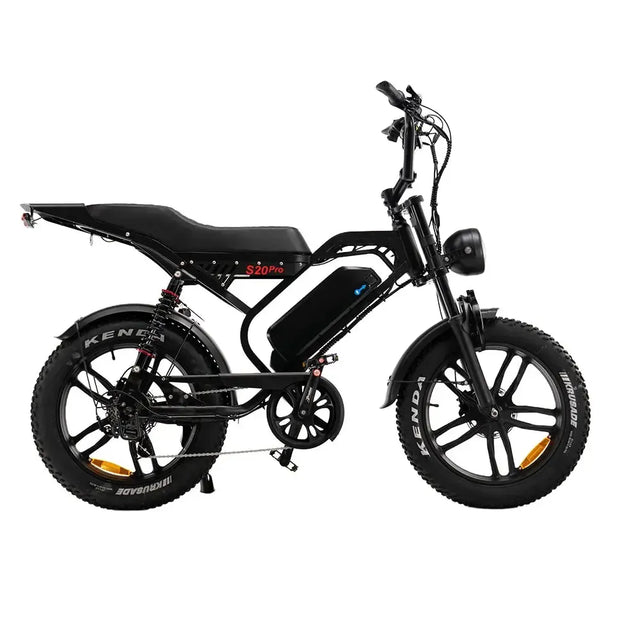

V20 Pro, Skinny Bike, Black
OUXI GT-20 Pro: banden van 20 x 4,0 inch
Volgens OUXI rijdt de GT-20 Pro op banden van 20 x 4,0 inch. Voor en achter zitten hydraulische schijfremmen.
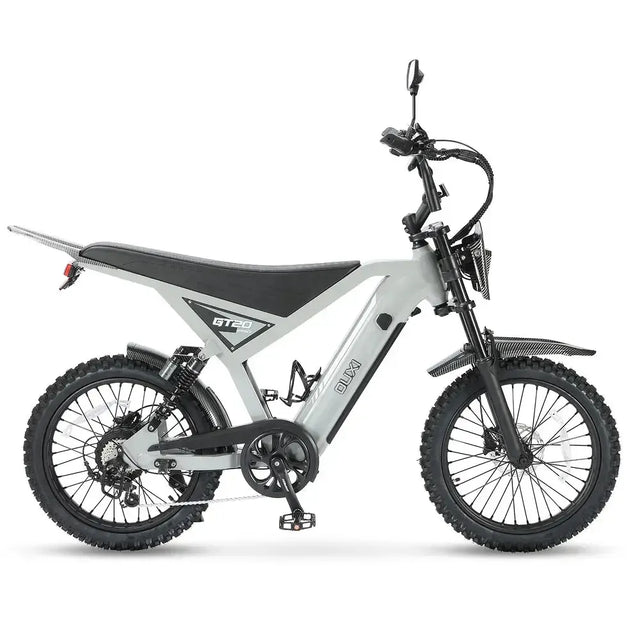
OUXI GT-20: vering voor en achter, zeven versnellingen
OUXI zet de GT-20 op banden van 20 x 4,0 inch, met vering voor en achter en zeven versnellingen. De hydraulische schijfremmen van Tektro hebben vier zuigers. Het maximale draaggewicht is volgens OUXI 150 kilo.
